Engineering case study
ARKANA Studio Company Profile
An editorial company-profile concept for an independent architecture atelier.
Overview
ARKANA Studio is a fictional architecture atelier created as a Surelabs portfolio demonstration. The concept package contains five standalone page mockups—Home, About, Services, Selected Projects, and Contact—plus a written design-system specification and screen captures.
The work explores how a specialist studio can explain its point of view, services, selected work, and inquiry process through an editorial company profile instead of a generic agency landing page.
The design challenge
The brief represented in the concept is a high-end architecture practice whose work depends on material, place, climate, and craft. A conventional grid of service tiles would not communicate that identity. The interface therefore uses the visual language of an architectural monograph: restrained navigation, carefully framed imagery, drawing-like labels, and long-form editorial sections.
The source itself labels ARKANA as a concept portfolio by SureLabsID. Studio biographies, addresses, project records, measurements, awards, and architectural imagery are fictional demonstration content, not a real firm’s credentials or built work.
Information architecture
- Home introduces the atelier concept, its positioning, featured monograph work, and core disciplines.
- About presents a studio philosophy, a speculative timeline, principal profiles, and material research narrative.
- Services groups the fictional practice into architecture and spatial planning, interior architecture, and tectonic craft and construction oversight.
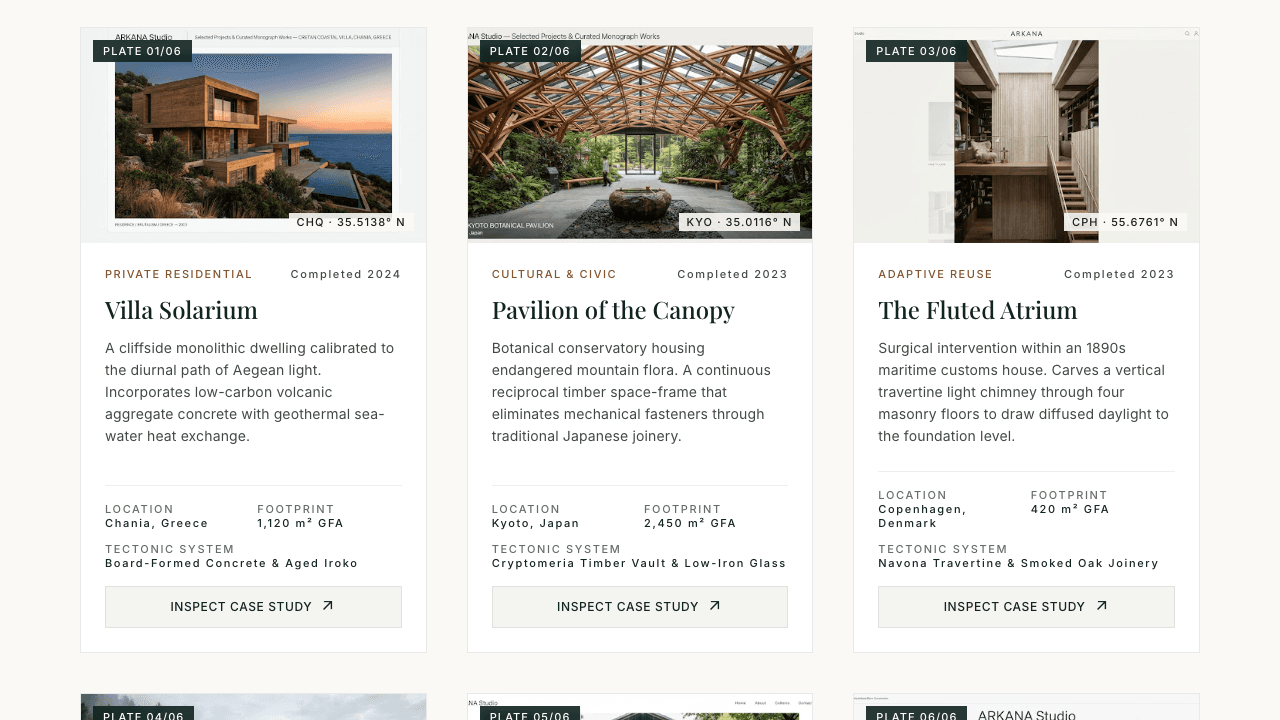
- Selected Projects presents a six-item sample archive with typology filters and a project-detail drawer interaction.
- Contact frames a commission inquiry with a structured brief form and sample correspondence details.
Editorial design system
The supplied design specification pairs Playfair Display headlines with Inter body copy. An alabaster background, deep spruce primary surfaces, and restrained bronze accents draw from stone, timber, and patinated metal. Generous margins give photography and long-form text room; hairline rules, small uppercase labels, and square corners keep the interface close to a printed monograph.
The page layouts shift between large image plates, technical captions, editorial columns, and dark closing sections. This establishes a consistent rhythm across the company story without making every page feel like the same card grid.
Interaction design
The Selected Projects mockup includes category filtering and opens a detail drawer for a chosen project. The Contact mockup explores a commission brief form and confirmation state as part of the interface presentation.
These are front-end prototype interactions. The supplied files do not establish that the form sends data, that project content comes from a CMS, or that the navigation is connected to a production site.
Front-end structure
The source is organized as standalone HTML page concepts, with Tailwind CSS loaded from its CDN and custom vanilla JavaScript for the project filtering and detail drawer. The package also includes a design-system document and screenshot files.
This structure keeps the demonstration easy to inspect, but it duplicates shared page elements and depends on a network connection for the CDN and remotely referenced imagery. It is a prototype format, not evidence of a production architecture or deployment.
Key decisions and trade-offs
- Use editorial typography, quiet colors, and generous whitespace to make architecture imagery and project narratives the main content.
- Use a distinct layout for each company-profile page while keeping navigation, labels, and visual tokens recognizable across the set.
- Use a filterable project archive and detail drawer to demonstrate a richer portfolio interaction without adding a separate route for every fictional building.
- Keep the implementation lightweight with static HTML and small client-side interactions; shared components, content management, form delivery, and production hosting are outside this concept package.
Outcome and next iteration
The delivered concept package demonstrates a complete company-profile journey across five page mockups, a documented visual system, and a selected-project interaction. It is suitable as a design and content-structure reference for an independent studio portfolio.
A production adaptation could move shared navigation and page layouts into reusable components, manage approved content as structured data, replace the fictional studio material with real project information, and connect the inquiry form to an explicitly chosen delivery service. Those are possible next steps, not features implemented in this package.
Concept disclosure
ARKANA Studio is not a real client or operating architecture firm. Its identity, biographies, locations, project names, specifications, awards, and architectural imagery are fictional demonstration material. This case study describes the website concept and prototype files only; it does not claim that the depicted buildings were designed or built by Surelabs.
Have a similar challenge?
Let's explore the right solution.
Tell us about the problem you’re working through and we can discuss a practical next step.
Discuss a project ↗